
Ethiopia’s Investment Incentive Reform 2026: Key Legal Shifts from Regulation 517/2022 to 586/2026
Introduction
Ethiopia has significantly revised its investment incentive regime with the replacement of Investment Incentive Regulation No. 517/2022 by the new Regulation No. 586/2026. This reform shifts the system from multi-year tax holidays and broad customs exemptions to a performance-based framework with targeted incentives. In essence, blanket income tax holidays are eliminated, replaced by reduced tax rates tied to priority sectors and performance, and new incentive categories (such as Special Economic Zones, start-ups, and green investments) have been introduced. The core customs duty benefits are largely retained but with refined conditions. This legal update outlines the key changes between the two regulations across five dimensions: tax incentives, customs duty incentives, administrative procedures, eligibility criteria, and sectoral priorities, and concludes with implications for investors and practitioners.
- Tax Incentives
Regulation 517/2022 provided generous income tax holidays – i.e., full exemption from business income tax – for a fixed duration depending on the sector and location of the investment. The annexed schedule sets out multi-year exemption periods (commonly ranging from about 3 to 7 years) for eligible sectors, with longer holidays for priority industries and projects outside Addis Ababa. Investors could also qualify for additional holiday years under certain conditions: for example, exporters were granted an extra two-year exemption if they achieved high export ratios (≥60% or 80%, depending on location), and investors creating large numbers of jobs for Ethiopians abroad earned up to three extra years of holiday. Any losses incurred during the tax holiday could be carried forward and deducted after the holiday for a period equal to half of the exemption years (capped at five years). However, no special dividend or capital gains tax incentives existed under Reg. 517/2022 – Those taxes applied as normal.
Regulation 586/2026 abolishes the old tax holiday model and replaces it with reduced corporate income tax rates for a limited period. Instead of paying 0% tax for a few years, qualifying investors now pay tax at a lower rate (e.g., 15%) for a longer incentive period. Specifically, most priority investments listed in the regulation enjoy a 15% income tax rate (half the standard 30% rate) for up to ten years (exact duration varies by sector). Certain high-priority categories get an even lower rate: for instance, Special Economic Zone developers and eligible start-up enterprises are taxed at only 5% for ten years. In addition, the new regulation extends tax incentives to shareholders and investors in ways the old law did not – for example, dividends distributed by SEZ developers and start-ups are exempt from dividend tax for five years, and gains from the sale of start-up shares can be exempt for early investors. Because companies under the Reg. 586 do pay some tax (albeit at reduced rates), loss carry-forward is handled under the ordinary income tax law (generally a five-year carry-forward); there is no special extended loss carry-forward beyond that.
In summary, the tax incentive paradigm has shifted from a time-bound zero-tax holiday to a “pay some tax, but less” approach. The incentive periods are comparable in length to the old holidays, but the government ensures a minimum tax inflow and ties the benefit more closely to continued performance (since poor compliance can lead to removal of the reduced rate).
Notably, Reg. 586 also introduces targeted tax incentives that did not exist before. For example, a company listing on the forthcoming Ethiopian stock exchange will pay tax at 25% (a 5-point reduction) for three years post-listing – a move to encourage capital market development. Environmental investments are recognized, too: a business engaged in carbon credit trading or achieving significant renewable energy usage qualifies for a 15% rate incentive for a set period. These kinds of incentives reflect new policy goals and were absent in Reg. 517.
- Customs Duty Incentives
Under Regulation 517/2022, investors with approved projects enjoyed broad customs duty exemptions on imported capital assets needed for their investment. This covered capital goods (plant, machinery, equipment) and construction materials, which could be imported free of import duties upon obtaining prior approval of a detailed item list. To encourage local sourcing, the regulation provided that if an investor bought such goods locally (from Ethiopian manufacturers), they would get a refund of the import duties paid on the inputs used to produce those goods. Investors were also allowed to import spare parts duty-free up to the value of 15% of their capital goods, within five years of starting operations. However, ordinary motor vehicles were effectively excluded from duty-free privileges – the extent of any vehicle duty exemption was left to be set by directives, and importantly, pickups and station wagon vehicles were expressly not eligible for duty exemption. All duty-free items were subject to strict use conditions: assets imported free of duty could only be transferred to another similarly eligible investor or otherwise sold domestically if the forgone duty was paid. Unused items could be re-exported to avoid duty. Violating these conditions (e.g., misusing duty-exempt goods) could trigger penalties under customs law.
Regulation 586/2026 continues the policy of relieving import taxes on investment-related goods, with some expansions and clarifications. Eligible investors can still import capital goods, construction materials, and now, certain project-specific vehicles or equipment, completely free of customs duty, and notably, the new regulation also ensures exemption from import-related taxes (like VAT) on those items. In other words, incentives now cover both customs duties and import VAT as a package. The procedural requirement to submit a detailed list or bill of quantities for approval remains in place. Duty-free privileges for locally sourced inputs also persist: if an investor purchases capital goods or materials from local manufacturers, they can claim a refund of the import duties/taxes embedded in those local inputs (maintaining a level playing field). The treatment of vehicles under Reg. 586 is still restrictive but slightly more accommodating: the regulation mandates that directives will specify what types of investment-related motor vehicles qualify for duty exemption (or reduction), whereas personal passenger cars remain excluded.
Reg. 586 also introduces improved administrative safeguards for customs incentives. It explicitly allows phased projects to continue importing duty-free in line with their project timeline, and it strengthens monitoring: regulatory bodies (the Customs Commission and EIC) must verify that imported items are used for the intended investment purpose, with annual or quarterly reporting on the usage of duty-exempt goods. The fundamental transfer rules are unchanged – duty-free imported goods can be transferred to another privileged holder or sold to non-privileged parties upon payment of duties, and can be re-exported, just as under the old regime19. In essence, the customs incentives regime in 2026 remains a key benefit for investors (duty and VAT exemptions significantly reduce capital expenditure), but it comes with tighter oversight to prevent misuse.
- Administrative Procedures and Oversight
Regulation 517/2022 administered incentives through the Ethiopian Investment Commission (EIC) and related bodies with straightforward procedures. Investors applied to EIC for an incentive certificate, and once granted, the tax holiday period commenced from the date of the investor’s business license. Beneficiaries were obliged to keep separate books of accounts for projects enjoying incentives and to file their financial statements with the tax authority annually, even during the holiday. If an investor failed to submit the required accounts or reports in any given year, the law stipulated that the tax exemption for that year would be lost. Various government organs had defined roles: EIC coordinated and monitored compliance, the Ministry of Finance issued clarifying directives, the Ministry of Revenue (Tax Authority) ensured no taxes were collected during lawful exemption periods and that taxes were duly collected afterwards, and the Customs Commission supervised duty-free importation. The old regulation also included basic anti-abuse provisions – for example, if an investor shut down a business that had enjoyed a tax holiday and then started a new company in a similar activity, they would not be allowed a new holiday for the period already used by the closed business. Penalties and revocation mechanisms were present but not highly elaborate in Reg. 517.
Regulation 586/2026 introduces a much more rigorous administrative regime centred on accountability and performance monitoring. A notable innovation is the requirement for many incentive recipients to enter into a Performance Agreement with the authorities as a precondition for the tax incentives. In a performance agreement, the investor commits to specific targets (such as investment amount, job creation, production output, export volumes, and technology transfer goals) and agrees to regular reporting. These agreements enable authorities to monitor whether the investor is delivering the promised economic benefits in exchange for the incentives. All investors enjoying the new incentives must be registered taxpayers and file regular tax returns and financial statements (even if paying a reduced rate) – essentially, maintaining continuous compliance with the Tax Authority is mandatory. Failure to adhere to the accounting and reporting obligations under Reg. 586 results in automatic suspension or loss of the incentive for the period in question, in addition to penalties under tax law.
The institutional responsibilities are also bolstered: the Ministry of Finance is empowered to issue detailed directives to guide implementation (for instance, defining eligible sub-sectors and lists of goods, and establishing monitoring mechanisms) and to conduct analyses of the costs and benefits of incentives. The EIC continues to serve as the primary liaison for investors – processing applications, verifying eligibility (including that the investor meets the new capital threshold and sector criteria), and monitoring compliance in collaboration with the Tax Authority and Customs. The Customs Commission must closely track duty-free imports and their usage and report any misuse. Inter-agency information sharing is emphasized under the new regulation to ensure any instance of non-compliance (like an investor not filing a report, or using imported goods improperly) is quickly communicated, and the incentives can be halted if necessary. The introduction of a Minimum Alternative Tax (MAT) in Ethiopia’s tax law is acknowledged: Reg. 586 provides that certain incentivized investors are initially exempt from MAT, but once that period lapses, even incentivized companies may have to pay a small minimum tax on profits – this ensures that after a decade of very low tax, companies cannot go entirely tax-free by perpetual losses or accounting adjustments.
In practical terms, the administrative changes mean investors will face stricter scrutiny and must be more proactive in compliance. The days of receiving an incentive certificate and then having minimal interaction for years are over; now there will be ongoing obligations (reports, performance reviews, and possibly mid-course evaluations against targets). For well-intentioned investors, these conditions simply mean better record-keeping and communication with authorities. For the government, these measures seek to maximize the actual economic gain from each incentive granted and to deter any abuse of the system.
- Eligibility Criteria
Under Regulation 517/2022, eligibility for incentives was broad in scope but tied to the sectors and activities listed in the regulation’s schedule. Essentially, any new or expanding investment in an approved sector (mostly manufacturing, agro-industry, certain export-focused services, and some infrastructure projects) qualified, regardless of size, if it was a new establishment or a qualifying expansion. There was no general minimum capital investment requirement in the law for an investor to get a tax holiday. This meant that even relatively small projects could technically enjoy full tax exemptions, although in practice most beneficiaries were medium to large enterprises. The old regime did, however, impose certain qualitative criteria: for expansions, the existing enterprise had to have achieved its licensed production capacity and met other preconditions before a new exemption would be granted. Additional incentives were provided to encourage investments in less-developed regions – as noted, an investor in a remote area could get a 30% tax reduction for three years after their holiday, or special extended holidays for hotels and lodges in designated “new tourist destination” areas. Also, some sectors were explicitly excluded from income tax incentives regardless of investment size: notably, mining and petroleum operations were not eligible for the standard tax holiday at all (since they have separate fiscal regimes), and various domestic-market service activities (e.g., trading, finance, routine services) were simply not listed as eligible and thus received no holidays.
Regulation 586/2026 tightens the entry requirements to ensure incentives are channeled to high-impact investments. First, it defines priority investment areas more strategically: only projects in certain sectors or activities designated as priorities (aligned with the country’s development plans) will qualify for the new tax rate incentives. These likely include export-oriented manufacturing industries, agro-processing, technology and ICT ventures, renewable energy projects, large-scale import-substitution industries, infrastructure development, and other sectors deemed crucial, as outlined in Table 1 of the regulation. Secondly, and importantly, the new regulation introduces a minimum capital investment threshold – generally, an investor must invest at least USD 10 million (or its equivalent in Birr) in the project to be eligible for the income tax incentives. This is a significant change: under the old law a $1 million factory and a $50 million factory could both get a 5-year tax holiday, but under the new law the smaller project would not qualify for the 15% tax rate incentive unless it meets the threshold (though there is an intention to cater to small and medium enterprises through separate directives). The high threshold reflects a policy decision to focus incentives on larger investments that presumably have greater potential for job creation, technology transfer, and foreign exchange earnings.
Additionally, qualitative eligibility criteria are emphasised. Investments must demonstrate they will create “additional production capacity or value addition” to the economy to qualify – ensuring that the incentive is given to projects that genuinely extend the country’s productive base, not just duplicate existing capacity. The authorities are likely to scrutinize business plans to confirm that a project is not simply a minimal expansion or a relocation of an existing business but adds new value.
Geographic incentive policy continues under the new regime, albeit in a flexible form: while Reg. 586 itself doesn’t list specific regional bonuses; it permits the government to extend or augment incentives for investments in underdeveloped areas via directives. This means the practice of rewarding investors who venture outside the main economic centres will carry on with the details (which regions, how much extra incentive) set in secondary legislation.
In summary, the eligibility bar under Reg. 586/2026 is higher and more focused: qualifying for incentives now requires being in a priority sector and meeting substantial investment size criteria, whereas Reg. 517/2022 cast a wider net with fewer minimum requirements. Sectors that were previously not incentivized (like purely domestic-oriented services or small-scale ventures) remain generally ineligible, and even within eligible sectors, an investor must often be of a significant scale to benefit. The intent is to concentrate the incentives on investments that will have the most meaningful impact on the economy.
- Sectoral Priorities
The contrast in sectoral focus between the two regulations reflects Ethiopia’s evolving economic priorities. Regulation 517/2022 was grounded in the industrialization strategy of the time. It prioritized manufacturing (light and heavy), agriculture and agro-processing, and certain strategic services (for example, investors in ICT parks or export logistics) as key areas for incentives. The annex list in 2022 offered varying holiday durations for these sectors and specifically incentivized export performance – granting additional tax exemption years for manufacturing or service investors outside industrial parks who exported at least 60% of their output (and similarly extra years for park-based manufacturers exporting ≥80%). Tourism development in less-travelled areas was also encouraged via extra holidays (e.g., a five-year income tax holiday for establishing a star-rated hotel in a designated emerging tourist destination). There were no dedicated incentives for emerging sectors like tech start-ups or green economy projects under Reg. 517 – such areas were not addressed in the 2022 scheme.
Regulation 586/2026 re-aligns incentives with the government’s current reform agenda, placing greater emphasis on innovation, sustainability, and high-value-added industries. The priority sectors under the new regulation are those that are capital-intensive and high-impact – for example, advanced manufacturing, agro-industrial processing, renewable energy, mining and mineral value-addition, ICT and innovation, and major infrastructure projects. The new incentives explicitly support start-up enterprises to spur technology and entrepreneurship, the development of Special Economic Zones and their tenant industries (to boost industrial exports), and environmental protection projects (such as investments in renewable power usage or carbon trading) as national priorities. Sectoral prioritization is more dynamic under Reg. 586 – The regulation allows the Ministry of Finance to update the list of incentivized sub-sectors via directives to respond to changing economic needs.
In broad terms, Reg. 586/2026 maintains support for traditional pillars like manufacturing and agriculture but broadens the scope to include modern sectors and strategically important activities, while phasing out blanket incentives for areas considered less impactful. This ensures that Ethiopia’s incentive programme is aligned with the “Homegrown Economic Reform” agenda and can adapt as new opportunities or challenges emerge in the economy.
Conclusion and Implications
The transition from Regulation 517/2022 to Regulation 586/2026 marks a strategic shift in Ethiopia’s investment incentives regime from a broad-brush approach to a more targeted and conditional model. The new framework is designed to reward investors who are aligned with Ethiopia’s development objectives – those bringing substantial capital, creating jobs, earning or saving foreign exchange, and introducing new technologies – while also safeguarding public revenue through minimal taxation and strict compliance oversight. For investors and legal practitioners, several key implications arise:
- For Investors: The incentive offerings remain attractive but are now concentrated on larger, high-impact investments. Investors planning projects in Ethiopia should evaluate whether their venture falls within a priority sector and meets the new criteria. Those that do can benefit from significant tax reductions and import duty savings, potentially improving project viability and returns. However, they should be prepared for a more engaged relationship with regulators: the need to sign performance agreements and regularly report progress means investors must commit to transparency and fulfill their promises. Compliance costs (such as maintaining robust accounts and documentation) may modestly increase, but these are outweighed by the incentive benefits if properly managed. Importantly, investors can no longer assume an automatic entitlement to a multi-year tax holiday – instead, the incentive is “earned” continually by performance and compliance. New entrants, especially in tech or green sectors, should take note of the new categories of incentives (for example, a recognized start-up can enjoy a token 5% income tax rate for ten years). Existing investors who had incentives under the old regime should consult with the EIC: transitional provisions allow them to continue with previously granted incentives until expiry or opt into the new regime if that proves more advantageous.
- For Legal Practitioners: Advising clients on Ethiopian investments now requires a nuanced understanding of the qualitative and quantitative criteria in Reg. 586/2026. Lawyers will need to guide investors through the process of negotiating and drafting Performance Agreements, ensuring that the agreed-upon targets are realistic and clearly defined to avoid future disputes or loss of incentives. There is also a role in helping clients structure their investments to meet the threshold and sector requirements – for example, consolidating capital or adjusting project scope to qualify for incentives, or identifying if an SME-focused directive could apply. Practitioners should be mindful of the ongoing compliance obligations: assisting clients in establishing proper accounting segregation for incentivized activities, scheduling timely filings and reports, and advising on any remedial actions if performance commitments are at risk of not being met. With the new regulation, the Ministry of Finance is expected to issue implementing directives; these will contain crucial details (such as precise sector definitions, procedures for SMEs, lists of eligible goods, etc.), so staying updated on those will be essential for providing accurate advice.
In conclusion, Ethiopia’s new investment incentive regime still offers substantial opportunities for investors, but in a framework that prioritizes outcomes and accountability. Investors who are willing and able to commit meaningful resources and meet performance expectations will find a supportive environment with significant fiscal benefits. On the other hand, projects that are too small or misaligned with national priorities may no longer enjoy special treatment. From a policy perspective, these reforms aim to ensure that the Ethiopian economy gains tangible value from every incentive granted, making the system more sustainable and effective. As Regulation 586/2026 is now in force, both investors and their advisors should align their strategies with the new incentive framework to fully leverage its opportunities while remaining compliant with its conditions.
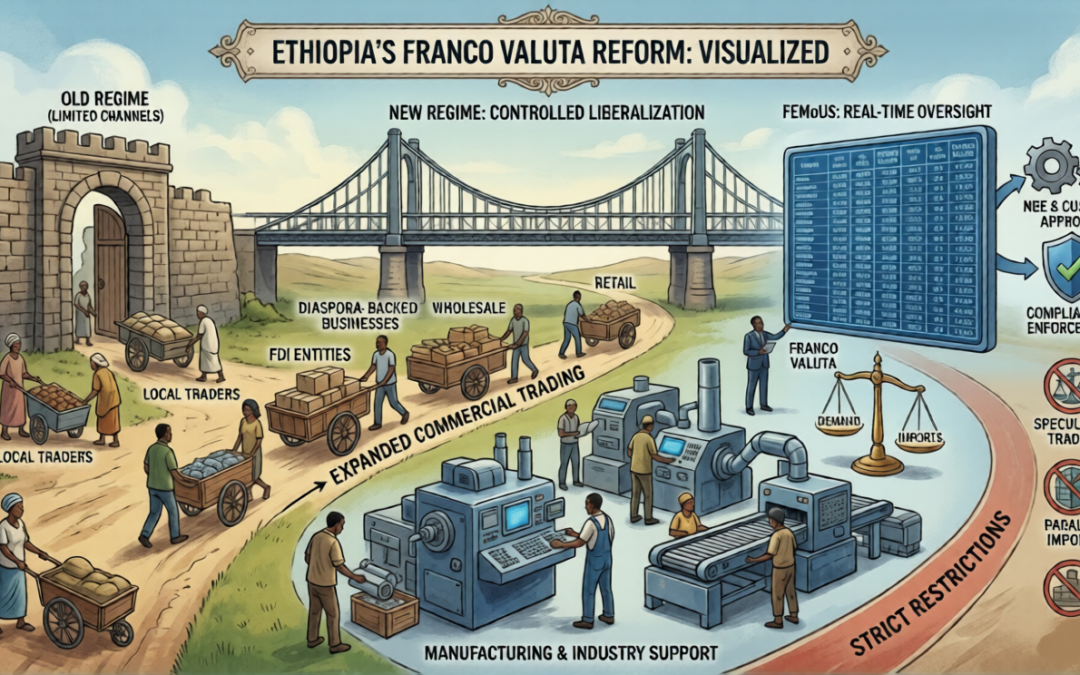
Ethiopia’s Franco Valuta Reform: Expanded Import Channels with Targeted Restrictions on Trading and Manufacturing
Businesses that combine strategic structuring with rigorous compliance will be best positioned to unlock the full commercial value of Franco Valuta.

Draft Amendment to the Federal Tax Administration Proclamation No. 983/2016
The Federal Democratic Republic of Ethiopia has introduced a draft amendment to the Federal Tax Administration Proclamation No. 983/2016, which establishes the legal framework governing tax administration, compliance, enforcement, and dispute resolution in Ethiopia.

Ethiopia’s Customs Valuation Reform: Bridging the Gap Between Directive and Practice
Customs valuation has long stood at the centre of Ethiopia’s trade, investment, and foreign exchange challenges. While revenue protection and foreign currency control remain legitimate state objectives, the persistent reliance on arbitrary reference prices—particularly under Customs Valuation Directive No. 158/2011—has created serious distortions in trade administration, banking operations, and domestic taxation. The recent circular issued by the National Bank of Ethiopia on January 26, 2026, requiring banks to use customs prices as a reference for Letters of Credit, has once again brought this debate to the forefront, exposing the far-reaching consequences of valuation practices that diverge from internationally accepted principles.
Legal Opinion in Capital Markets: Standards, Independence, and Verification
A) Why Legal Opinion?
Lawyers are envisaged to play pivotal roles in capital market especially in security registration.
Investor Protection: Legal opinions often assess existential risks like litigation, asset ownership, and regulatory compliance. A biased opinion could mislead investors.
Market Integrity: Capital markets rely on trust. Conflicted legal opinions undermine transparency and fairness.

Foreign national’s ownership rights of residential houses, Proclamation No. 1388/2025
The ownership rights of foreign nationals over residential houses are governed by Proclamation No. 1388/2017. The proclamation consists of twenty-one (21) articles organized into four sections.

Legal Insight: New Developments in Ethiopia’s Foreign Exchange Framework
Following the comprehensive macroeconomic reform program, the National Bank of Ethiopia (NBE) has undertaken significant measures aimed at liberalizing the foreign exchange regime and fostering the development of a more efficient and market-oriented forex system. A central pillar of these reforms has been the gradual removal of current account restrictions and the introduction of regulatory flexibility designed to stimulate foreign exchange inflows, encourage investment, and enhance market confidence.
The licensing and supervision of banking business reserve requirements (9th replacement) directive number SBB/97/2025
By Kaleegziyabher Gossaye.
Legal update on The licensing and supervision of banking business reserve requirements (9th replacement) directive number SBB/97/2025

Risk Based Capital Adequacy Requirements for Banks-Directive No. SBB/95/2025
By Kaleegziyabher Gossaye.
The directive is organized into six parts. The first part outlines the general provisions of the directive. The second part deals with definition of capital. The third part discusses the capital requirements for credit risk. The forth and the fifth part extend to the capital requirements of market risks and operational risks. The last part, but not the least, is dedicated to miscellaneous provisions.

Ethiopia’s Amended Income Tax Proclamation: Implications for Revenue, Professionals, & Investors
The goals of the amendment are typically outlined in the preamble of the proclamation. Therefore, the objectives mentioned in the preamble include: improving revenue collection through adjustments to the rates applied to certain incomes; expanding the tax base; creating an efficient system of tax incentives; and curbing tax avoidance strategies, which encompass restrictions on cash payments.

U.S. International Tax Law in a Coffee Bean
The highlands of Ethiopia are widely regarded as the birthplace of coffee. The story of Ethiopian coffee dates back to around 850 AD, when both Arabica and Robusta coffee are believed to have originated. Today, Ethiopia remains the top coffee producer in Africa, cultivating over 5,000 varieties. Coffee is a major global export for the country, where agriculture remains a key driver of the economy. Ethiopia also ranks first in wheat production and third in maize production across Africa.